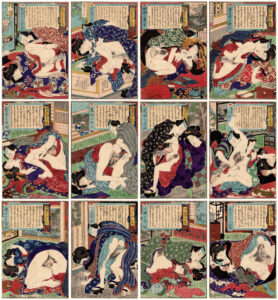
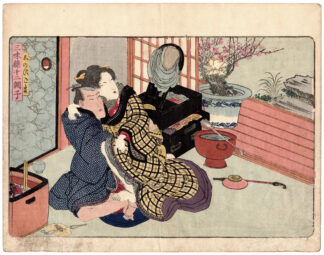
Japanese woodblock prints encompass several distinct artistic traditions that evolved between the Edo period and the twentieth century. While collectors often associate traditional printmaking exclusively with ukiyo-e, Japanese artists and publishers developed specialized genres ranging from suggestive romantic compositions to literary frontispieces and modern creative prints.
Understanding these classifications helps collectors identify the historical context, production method, and aesthetic purpose behind each work. As explained in our post on how Japanese woodblock prints are made, traditional workshops relied on a collaborative system, whereas later movements redefined the role of the individual artist.
Ukiyo-e Woodblock Prints
Ukiyo-e, meaning “pictures of the floating world,” is the foundational genre of Japanese printmaking that flourished from the seventeenth through the nineteenth centuries. Produced through the classic hanmoto publishing system, these works required an artist to draw the design, a carver to cut the cherrywood blocks, and a printer to apply water-based pigments by hand.
Typical subjects include kabuki actors, courtesans, landscapes, historical warriors, and scenes of urban leisure. You can explore original Edo and Meiji period impressions in our ukiyo-e woodblock prints collection.
Abuna-e and Sensual Tension
Literally translating to “dangerous pictures,” abuna-e captures a withheld sensual charge poised right on the threshold of explicit representation. Rather than depicting graphic sexual acts, these compositions convey desire through passionate embraces of clothed lovers, playful resistance, voyeuristic glances, and delicate summer yukata revealing the contours of the body beneath.
By keeping erotic tension suspended without crossing into explicit territory, abuna-e achieves a distinctive balance between provocation and aesthetic grace. Collectors can explore original works in this genre in our abuna-e woodblock prints section.
Kuchi-e Frontispiece Prints
Kuchi-e (“mouth pictures”) was a term already used during the Edo period to designate opening frontispiece illustrations bound at the beginning of woodblock-printed books. Later, it became most widely associated with the fold-out frontispieces created during the Meiji and Taisho eras for literary magazines and novels.
Designed to anticipate the mood and characters of a volume before the narrative unfolds, these prints are known for their refined linework and subtle shading, with Meiji literary examples often retaining their original fold lines, as seen in our kuchi-e woodblock prints archive.
Shin-hanga New Prints
Emerging in the early twentieth century alongside the rise of modern printmaking, the shin-hanga (“new prints”) movement sought to revitalize the traditional collaborative workshop system. Spearheaded by visionary publishers and artists during the Taisho and early Showa eras, it preserved the classic division of labor between designer, carver, and printer.
At the same time, shin-hanga modernized traditional subjects—such as landscapes, beauties, and nature studies—by incorporating Western-influenced light, atmospheric depth, and nuanced color gradations.
Sosaku-hanga Creative Prints
Emerging in the early twentieth century, the sosaku-hanga (“creative prints”) movement broke away from traditional division of labor. Influenced by Western modernist ideals of individual expression, sosaku-hanga artists insisted on drawing, carving, and printing their own blocks entirely by themselves.
This hands-on approach produced bold textures, experimental compositions, and visible woodgrain effects, which are showcased in our sosaku-hanga woodblock prints selection.