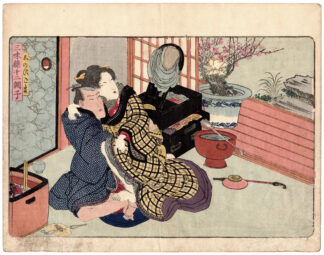
Traditional Japanese woodblock prints are made through a collaborative process uniting a publisher, artist, carver, and printer using cherrywood blocks. Rather than being produced by a single painter alone, each print relies on specialized artisans working in sequence to transfer a drawn design onto handmade mulberry paper.
The four artisans behind every print
In historical workshops from the Edo through the Showa periods, printmaking functioned as a refined division of labor. A publisher commissioned the work, financed production, and coordinated the team according to market demand. The artist then drew the master design in black ink on thin, translucent paper.
Next, a skilled carver pasted this drawing face-down onto a seasoned block of mountain cherrywood (yamazakura). Using chisels and gouges, the carver cut away the negative spaces, leaving the artist’s lines in crisp relief. Finally, a master printer applied water-based pigments to the raised surfaces and rubbed the back of damp paper with a circular pad called a baren to transfer the image.
How multiple colors are layered
Polychrome prints, known as nishiki-e or brocade pictures, require a separate carved block for each color in the composition. After carving the primary black outline block (omohan), the carver produced individual color blocks using proof sheets pulled from the key block.
To keep every hue perfectly aligned, the carver cut two small notches—a right-angled corner mark (kagi) and a straight edge guide (hikitsuke)—directly into each wooden block. During printing, the artisan rested the sheet against these registration marks (kento), allowing dozens of overlapping color impressions to align with millimeter precision.
Papers, pigments, and special effects
Artisans printed on washi, a resilient paper crafted primarily from the inner bark of the paper mulberry tree (kozo). Depending on the era and workshop, sheets were either formed by hand on bamboo screens or produced with period mechanical methods, both offering the long fibers required to absorb repeated damp pressings without tearing.
Printers worked with organic and mineral colorants mixed with rice paste directly on the woodblock, enabling subtle tonal gradations known as bokashi. Luxury editions also featured uninked blind embossing (karazuri), metallic mica powders, or burnished lacquer accents. Collectors interested in exploring these historic techniques up close can browse our catalog of original Japanese woodblock prints.